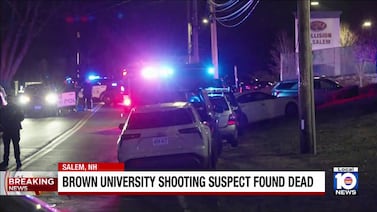
PROVIDENCE, R.I. (AP) — A man who is suspected of killing two and wounding several others at Brown University has been found dead in a New Hampshire storage facility, officials said.
Claudio Neves Valente, 48, a Brown student and Portuguese national, was found dead Thursday evening from a self-inflicted gunshot wound, Col. Oscar Perez, the Providence police chief, said at a news conference.
Valente’s last known address was located in Miami, according to records obtained by Local 10 News on Thursday.
Investigators believe Valente is responsible for both the shooting at Brown and the killing of a Massachusetts Institute of Technology professor who was fatally shot in his Brookline home Monday, a law enforcement official told The Associated Press. Authorities have not formally confirmed a connection between the two shootings.
The official could not publicly discuss details of the ongoing investigation and spoke to AP on condition of anonymity.
Two people were killed and nine were wounded in the mass shooting Saturday at Brown University. The investigation had shifted Thursday when authorities said they were looking into a connection between the Brown mass shooting and an attack two days later near Boston that killed MIT professor Nuno F.G. Loureiro.
The FBI previously said it knew of no links between the cases.
How the Brown investigation has unfolded
It has been nearly a week since the shooting at Brown. Frustration mounted in Providence that the person behind the attack managed to get away and that a clear image of their face hadn’t emerged.
A second individual who was identified in proximity to the suspect came forward after Wednesday’s press conference and helped “blow the lid” off the case, Rhode Island Attorney General Peter Neronha said.
“When you crack it, you crack it. That person led us to the car, led us to the name,” Neronha said.
Although Brown officials say there are 1,200 cameras on campus, the attack happened in an older part of the engineering building that has few, if any, cameras. And investigators believe the shooter entered and left through a door that faces a residential street bordering campus, which might explain why the cameras Brown does have didn’t capture footage of the person.
What can be learned from past investigations?
In such targeted and highly public attacks, the shooters typically kill themselves or are killed or arrested by police, said Katherine Schweit, a retired FBI agent and expert on mass shootings. When they do get away, searches can take time.
In the 2013 Boston Marathon bombing, it took investigators four days to catch up to the two brothers who carried it out. In a 2023 case, Army reservist Robert Card was found dead of an apparent suicide two days after he killed 18 people and wounded 13 others in Lewiston, Maine.
The man accused of killing conservative political figure Charlie Kirk in September turned himself in about a day and a half after the attack on Utah Valley University’s campus. And Luigi Mangione, who has pleaded not guilty to murder charges in the killing of UnitedHealthcare CEO Brian Thompson in Manhattan last year, was arrested five days later at a McDonald’s in Pennsylvania.
MIT mourns the loss of an esteemed professor
Loureiro, who was married, joined MIT in 2016 and was named last year to lead the school’s Plasma Science and Fusion Center, where he worked to advance clean energy technology and other research. The center, one of MIT’s largest labs, had more than 250 people working across seven buildings when he took the helm. He was a professor of physics and nuclear science and engineering.
He grew up in Viseu, in central Portugal, and studied in Lisbon before earning a doctorate in London, according to MIT. He was a researcher at an institute for nuclear fusion in Lisbon before joining MIT, the university said.
“He shone a bright light as a mentor, friend, teacher, colleague and leader, and was universally admired for his articulate, compassionate manner,” Dennis Whyte, an engineering professor who previously led MIT’s Plasma Science and Fusion Center, told a campus publication.
Loureiro had said he hoped his work would shape the future.
“It’s not hyperbole to say MIT is where you go to find solutions to humanity’s biggest problems,” Loureiro said when he was named to lead the plasma science lab last year. “Fusion energy will change the course of human history.”
___
This story was updated to delete a reference to MIT being an Ivy League school.
___
Richer and Tucker reported from Washington. Associated Press reporters Mark Scolforo in Harrisburg, Pennsylvania, and Hallie Golden in Seattle contributed.
Copyright 2025 The Associated Press. All rights reserved. This material may not be published, broadcast, rewritten or redistributed without permission. Copyright 2025 by WPLG Local10.com - All rights reserved.
